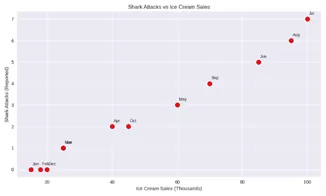
The debate over correlation versus causation has stirred up many conversations in the scientific community. While some see a clear connection between two factors, others argue that it may be misleading to assume that one thing directly causes another. This confusion has been present in various studies, including the supposed link between ice cream sales and shark attacks.
The idea that ice cream sales could potentially cause shark attacks may seem absurd at first glance. However, data has shown that both ice cream sales and shark attacks tend to increase during the summer months. This statistical association has led many to believe that there is a direct relationship between the two. But is this really the case?
Before jumping to conclusions, it is essential to understand the difference between correlation and causation. Correlation simply means that two variables are related in some way – they may increase or decrease together, but this does not necessarily mean that one is the cause of the other. On the other hand, causation refers to a direct cause-and-effect relationship between two things.
In the case of ice cream sales and shark attacks, the correlation is undeniable. As the temperature rises and people flock to the beach, ice cream sales also tend to increase. At the same time, more people are also spending time in the ocean, leading to a rise in shark attacks. This correlation is evident in the data, but does it mean that ice cream sales cause shark attacks? Of course not.
It is easy to fall into the trap of confusing correlation with causation, especially when the association seems apparent. However, correlation does not always imply causation. In fact, there may be other factors at play that are causing both ice cream sales and shark attacks to increase during the summer months.
One possible explanation is the weather. As the temperature rises, people are naturally drawn to ice cream and the beach. But this also means that the water temperature increases, making it more inviting for sharks. It could be argued that the weather is the underlying factor that influences both ice cream sales and shark attacks.
Another factor to consider is the media. When a shark attack occurs, it often receives widespread coverage in the news, causing a heightened fear of shark attacks. This fear can lead to a decrease in beachgoers, thereby resulting in a decrease in ice cream sales. Similarly, when there is a decrease in shark attacks, people may feel safer and more likely to visit the beach and indulge in ice cream.
Moreover, it is essential to note that correlation does not equal causation, but causation always implies correlation. In other words, a direct cause-and-effect relationship between two things will always result in a correlation. However, just because two things are correlated does not mean that one caused the other.
So, to answer the question of whether ice cream sales cause shark attacks, the answer is a resounding no. While it may seem like there is a link between the two, it is crucial to remember that correlation does not equal causation. Other factors, such as weather and media attention, may be influencing the increase in both ice cream sales and shark attacks during the summer months.
In conclusion, the confusion between correlation and causation is a common mistake made in various studies. While it may be tempting to draw direct conclusions from correlations, it is essential to consider other factors that may be at play. As for the supposed link between ice cream sales and shark attacks, it is clear that there is no causation between the two. So, next time you enjoy a scoop of ice cream at the beach, you can rest assured that you are not increasing your chances of a shark attack.