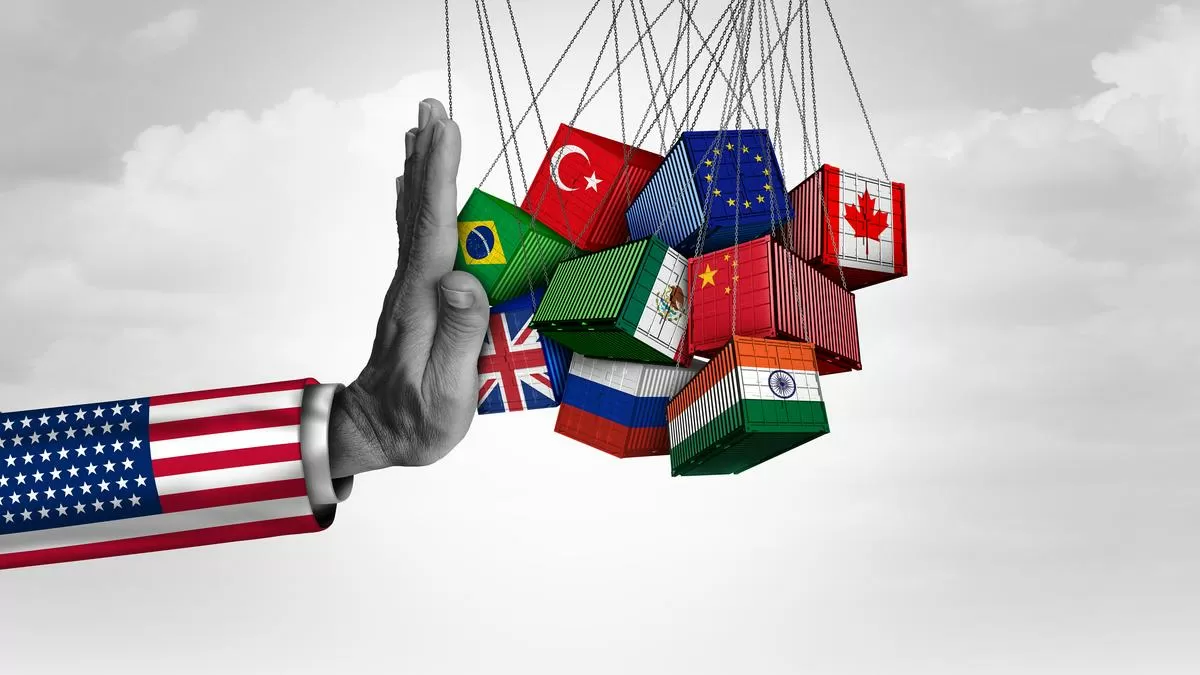
The topic of trade has been a contentious issue in recent years, with the United States constantly arguing for fairer trade deals. However, in the midst of all the debate, experts have shed light on a surprising fact – India’s actual tariff burden on American goods is lower than what is perceived.
For years, the US has accused India of imposing high tariffs on American goods, hindering the growth of their exports to the Indian market. President Donald Trump has even gone as far as calling India the “tariff king”. These accusations have been a major point of contention between the two countries, leading to a strained trade relationship.
But upon closer examination, it is evident that the actual tariff burden on American goods in India is significantly lower than what is believed. In fact, according to a recent report by the US International Trade Commission, the average tariff rate on American goods exported to India is just 13.8%, which is much lower than the perceived 20.3%.
This revelation has sparked a new debate on the fairness of the US’ accusations against India. Many experts argue that the US has been exaggerating India’s tariff rates to justify their demands for better trade deals. They also point out that the US itself has higher tariff rates on certain products, such as agricultural goods, which can go up to 300%.
So why is there such a huge discrepancy between the perceived and actual tariff burden on American goods in India? One of the main reasons is the complex structure of India’s tariff system. India has multiple levels of tariffs, including basic customs duty, countervailing duty, and special additional duty. These different levels of tariffs can often lead to confusion and misinterpretation.
Moreover, India has also been making efforts to reduce its tariff rates in recent years. In 2019, India slashed its tariff rates on a wide range of products, including electronics, auto parts, and medical devices. This move was aimed at boosting domestic production and attracting more foreign investment. It also demonstrates India’s commitment to promoting a more open and fair trade environment.
Another factor that needs to be considered is the overall trade balance between the two countries. While the US may argue that India’s high tariffs are hurting their exports, the reality is that the trade balance between the two countries is in India’s favor. In 2019, India’s exports to the US were worth $83.2 billion, while its imports from the US were only $35.5 billion. This clearly shows that India is not intentionally imposing high tariffs to protect its domestic market.
In fact, India has been taking steps to address the US’ concerns and improve the trade relationship between the two countries. In 2019, India announced a reduction in tariffs on certain US goods, including medical devices, in an effort to address the US’ trade deficit. This move was welcomed by the US, and it shows that India is willing to negotiate and find a mutually beneficial solution.
It is also important to note that India’s high tariffs are not unique. Many other developing countries have similar tariff rates, and it is unfair to single out India for it. What is more important is to focus on creating a level playing field for all countries and promoting fair trade practices.
In conclusion, the perception that India has high tariff rates on American goods is not entirely accurate. The actual tariff burden is much lower, and India has been taking steps to further reduce it. It is time for the US to acknowledge these facts and work towards a more balanced and fair trade relationship with India. Both countries have much to gain from a strong and mutually beneficial trade partnership, and it is crucial for them to move past these misconceptions and work together towards achieving it.