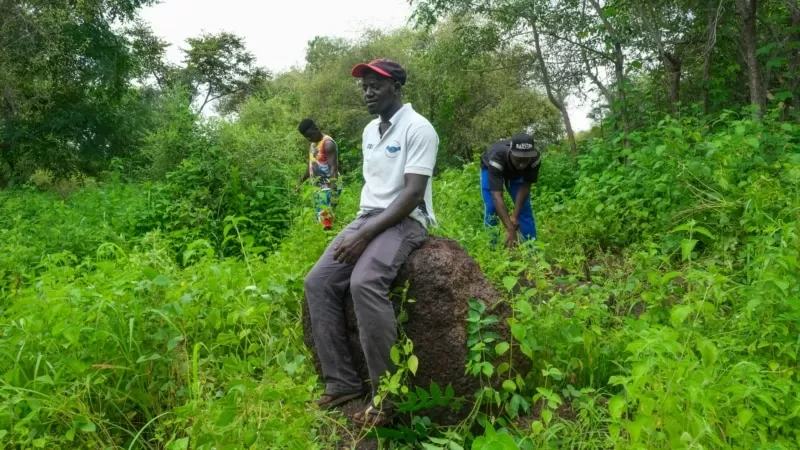
Kansala, Guinea-Bissau – For centuries, the history of the West African kingdom of Kaabu has been passed down through oral tradition. From father to son, or through the songs of griots – West African oral historians – the story of Kaabu has been kept alive. But now, thanks to a recent archaeological dig in Kansala, the once wealthy capital of the kingdom, the history of Kaabu is being brought to light in a whole new way.
Kaabu existed from the mid-1500s to the 1800s and at its peak, it encompassed Guinea-Bissau and reached into what are now Senegal and Gambia. The kingdom’s story has been immortalized in the songs of griots, who sang about the rulers of Kaabu. But for many, it was just a legend, until now.
Nino Galissa, a direct descendant of the griots who sang for the last emperor of Kaabu, recounts in a recent song commissioned by archaeologists, “The griots have already sung it, but now we know it’s real.” This sentiment captures the significance of the recent archaeological findings in Kansala, which are shedding new light on the history of Kaabu.
The song performed by Galissa is being shared along with a report of the archaeological findings by Sirio Canos-Donnay from the Spanish National Research Council, which was a lead institution of the dig. Canos-Donnay explains, “He’s combined all of the ways and methods and phrases that are the trade of the griot with the archaeological information and, hence, using that we’ll be able to transmit what we’ve done to the local population in a much more effective manner.”
In Kansala, griots have long been the keepers of history, passing down lessons from one generation to the next through their songs. Accompanied by the kora, a string instrument that resembles both a harp and a guitar, griots have preserved the history of Kaabu for centuries.
Antonio Queba Banjai, a descendant of the last emperors of Kaabu, remembers listening as a young boy to the griots sing about his ancestors. He emphasizes the importance of griots in African history, stating, “Griots are not just important, they are the puzzle you cannot miss in African history, because to know what we know now is because of griots. I am from the tree of the last emperor of Kaabu. We were educated by the music of kora. The storytellers tell us where we come from.”
Banjai is also the president of Guinea-Lanta, an NGO that worked closely with the archaeologists on this project. From the beginning, the team knew they wanted griots and oral history to play a significant role in the dig, which is the biggest archaeological project to ever take place in Guinea-Bissau.
Canos-Donnay hopes that including oral storytelling in the report will show the academic world that things can be done differently and more inclusively. She explains, “We should pay and need to pay respect to local ways of producing and consuming history. And the collaboration and the knowledge that can come from that dialogue from these two disciplines is something that is quite extraordinary.”
The team worked closely with griots to verify the accuracy of the events that had been sung about for generations. One such event was the explosive ending of the kingdom. Canos-Donnay shares, “Kansala had a fairly spectacular end in the 1860s, when the town was sieged by an enemy kingdom, and the local king realized he was going to lose the battle. The legend is he set fire to the gunpowder house and blew the whole site up. So, this particular point of the site is where the elders said it happened. And one of the fun things is we proved that’s where it properly did.”
The dig also uncovered evidence of extensive trading between the residents of Kansala and Europeans, including Venetian beads and Dutch gin. Joao Paulo Pinto, the former director of Guinea-Bissau’s National Institute of Study and Research, believes that West African ways of recording history should be taken just as seriously as European techniques. He states, “In our system, when you talk about the ritual of passage – everything has a process, everything has a code of