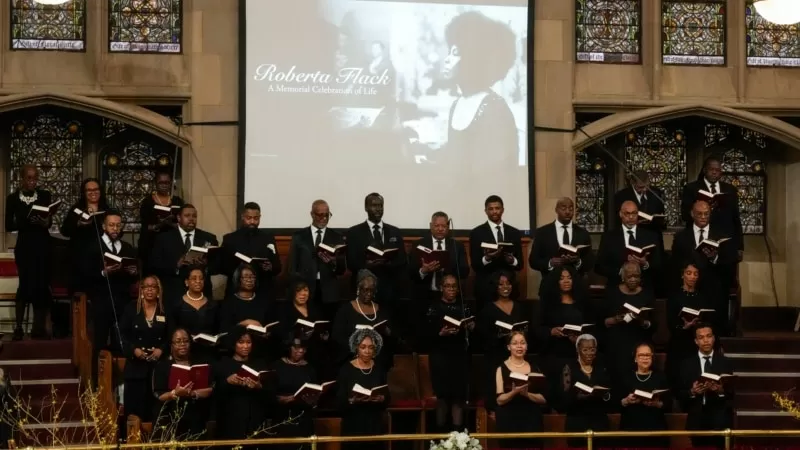
NEW YORK — On a beautiful spring day in Harlem, the historic Abyssinian Baptist Church was filled with the sound of choral music and the sweet melodies of the Berklee College of Music’s Nebulous String Quartet. The occasion was a public memorial service to celebrate the life and legacy of the late Grammy-winning singer and pianist, Roberta Flack.
Flack, who passed away last month at the age of 88, was a global star known for her soulful and intimate vocal style. Her songs, such as “The First Time Ever I Saw Your Face” and “Killing Me Softly with His Song,” captivated audiences in the 1970s and continued to do so for decades.
The memorial service was a beautiful tribute to Flack’s life and career, with performances by renowned artists such as Stevie Wonder and a eulogy delivered by the Rev. Al Sharpton. The service was livestreamed on Flack’s website and YouTube, allowing fans from all over the world to join in the celebration of her life.
The location of the service, The Abyssinian Baptist Church, was a fitting choice. Founded in 1808, it is one of the oldest Black Baptist churches in the United States. The church was adorned with stunning white and yellow bouquets, and a screen displayed a young Flack at the piano, along with highlights from her career.
Flack’s love for music was deeply rooted in her upbringing. Her mother played the organ at the Lomax African Methodist Episcopal Church in Arlington, Virginia, and as a teenager, Flack began accompanying the church choir on piano. It was clear from a young age that she had a special gift for music.
The program for the memorial service featured a powerful quote from Flack: “Remember: Always walk in the light. If you feel like you’re not walking in it, go find it. Love the Light.” These words perfectly encapsulate Flack’s positive and uplifting spirit, which she shared through her music.
The service was a true celebration of Flack’s life, with music being the centerpiece. The Rev. Dr. Kevin R. Johnson, the senior pastor of the church, led the service and spoke about how Flack had touched the hearts and souls of so many people. The choir performances, including a powerful rendition of “Amazing Grace,” were interspersed with video recollections of Flack’s life and scripture readings.
As the service came to a close, Johnson exclaimed, “That’s what we call church, y’all,” after a particularly moving choral performance. The sounds of organ and piano filled the church, a reminder of Flack’s incredible talent and her love for music.
One of the highlights of the service was when Santita Jackson, daughter of the Rev. Jesse Jackson and a friend of Flack, took to the stage to speak about the singer. “She just sang the song. She let you hear the lyrics. She let you understand the beauty. But I also want you to understand that this woman was also a pure genius,” Jackson said, highlighting Flack’s musical genius and her ability to touch people’s hearts with her music.
Actress Phylicia Rashad also shared her memories of Flack, recalling the first time she saw her perform while she was a student at Howard University. Rashad described how the audience was captivated by Flack’s quiet and steady voice. She also spoke about Flack’s humility and how she lived her life attending to the things she cared for most: music, love, and humanity.
Flack’s music was a unique blend of soul, jazz, gospel, and folk, making it difficult to categorize. Her debut album, “First Take,” was a perfect example of this, showcasing her versatility and musical prowess. However, she will always be remembered for her timeless classics, such as “The First Time Ever I Saw Your Face” and “Killing Me Softly with His Song.”
Flack’s cover of “The First Time Ever I Saw Your Face,” written by English folk artist Ewan MacColl, marked the beginning of her mainstream success when it was featured in Clint Eastwood’s 1971 film “Play Misty for Me.” But it was her rendition of “Killing Me Softly with His Song” that truly captured the hearts of audiences. Flack first heard the song while on a plane and immediately fell in love with it. She