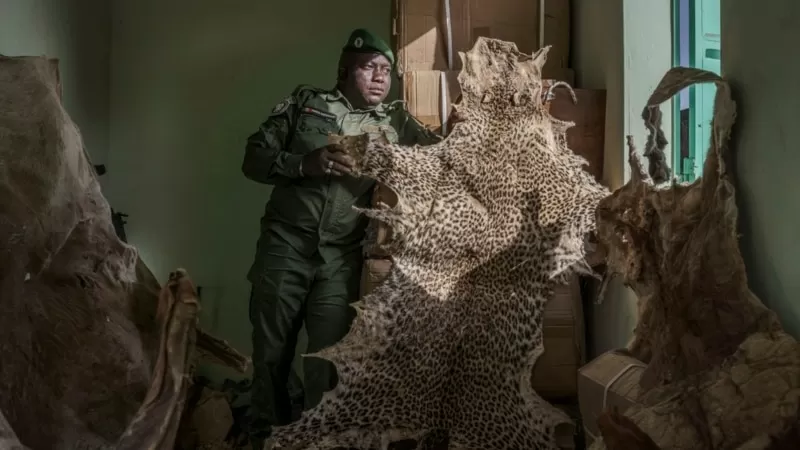
Niokolo-Koba National Park, Senegal – a gem of West Africa that holds within its borders a rich diversity of wildlife and a thriving ecosystem. The morning sun casts its warm glow through the dense canopy as Sgt. Abdou Diouf and his brigade of rangers make their way through the park, guns at the ready. They scan the bushes for any signs of poachers, but today they are met with a peaceful scene – the only hunters in sight are the majestic lions themselves, their fresh tracks imprinted in the soft sand.
Encompassing over 9000 square kilometers, Niokolo-Koba National Park is the last stronghold for lions in Senegal, a critically endangered species in this region. However, even within the protected boundaries of the park, these regal creatures face numerous threats.
According to a recent report by the wild cat conservation group, Panthera, the illegal trade of lion and leopard parts has been on the rise in Senegal. An alarming 80% of markets surveyed were found to be selling these forbidden items, with 63% of artisans reporting an increase in sales in recent years.
The impact of this illegal trade on the lions of Niokolo-Koba has been devastating. Despite enhanced protection measures that have doubled the population to around 35 since 2017, an average of two lions are still lost to poachers each year. This not only poses a threat to the survival of this species but also jeopardizes the park’s status as a UNESCO World Heritage Site.
The only other place where lions can be found in West Africa is the W-Arly-Pendjari Complex, a border region of Benin, Burkina Faso, and Niger. According to Panthera, there are fewer than 250 adult lions left in this region. This makes Niokolo-Koba National Park a crucial sanctuary for these majestic creatures.
So, what is driving the demand for lion and leopard parts? The answer lies in deeply rooted beliefs in the mystical powers of animal skin talismans, commonly known as “gris-gris.” These amulets are crafted from bits of animal skin with written prayers or Quranic verses sewn inside and are believed to possess supernatural abilities. The gris-gris are widely used across Senegal, with people from all walks of life donning them for various purposes.
However, for lions, this belief has proven to be fatal. As the national emblem of Senegal, the image of the “king of the jungle” adorns everything from the country’s coat of arms to its beloved national soccer team. This makes lion parts particularly alluring for those seeking the perceived powers of the gris-gris.
The demand for these forbidden items has led to the rise of a complex smuggling network that spans the continent. The skins, most likely sourced from East and Southern Africa, travel through clandestine routes, evading checkpoints and border security, to reach their final destination in Senegal.
Despite the efforts of conservation groups like Panthera, who have tripled the anti-poaching force in Niokolo-Koba National Park and invested millions in infrastructure and equipment, the battle against poaching remains challenging. The deeply ingrained cultural beliefs and the alluring promise of supernatural powers make it a tough network to dismantle.
The impact of the illegal trade is not limited to lions alone. The conservation group EAGLE Network reported that since 2019, 40 lion and leopard skins have been confiscated in Senegal, but this represents only a fraction of the actual trade. Traffickers have resorted to cutting lion skins into thousands of pieces to evade detection in local markets.
The biggest challenge, however, lies in countering the deeply ingrained cultural beliefs that fuel the demand for lion parts. As Dr. Cheikh Babou, a history professor and expert in West African Islam at the University of Pennsylvania, explains, gris-gris are deeply rooted in traditional African faiths that believe in the unlocking of vital powers in animals and nature. He says, “With Islam’s arrival in West Africa in the eighth century, gris-gris became hybrid objects, melding Quranic verses with the perceived powers of animal parts.”
The role of gris-gris in Senegalese culture is complex and deeply rooted. They are seen as a source of protection against curses and as a means to achieve success and prosperity. However, the use of gris-gris also holds a darker side. In traditional African societies, those