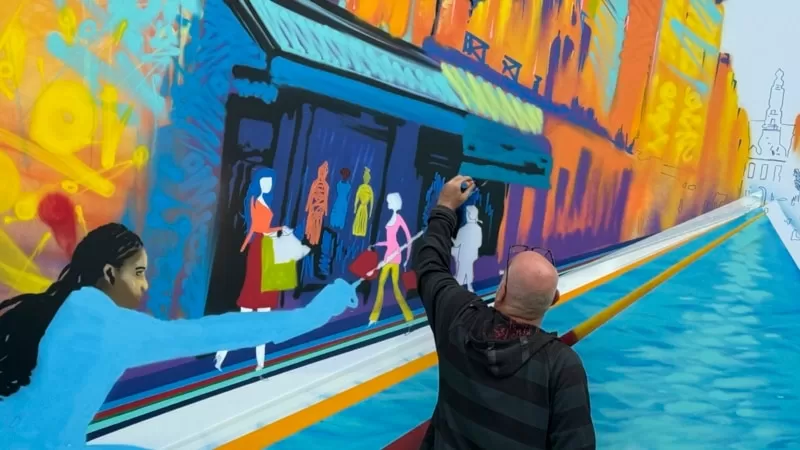
PARIS – The streets of Paris are now adorned with a colorful splash of Olympic spirit, as nearly 30 vibrant street art pieces have popped up on bustling metro station walls, a large billboard at the airport, and in front of City Hall.
These stunning artworks showcase a wide range of Olympic and Paralympic themes, from French fencer Ysaora Thibus in action to canoers paddling down the Seine River. They also capture the energy and diversity of Paris, with some pieces depicting people enjoying themselves in a busy district. Spread throughout the city and other nearby host cities, these original art pieces are a testament to the creative spirit of the Olympics.
The idea for this street art campaign was spearheaded by Visa, with the aim of supporting small businesses and promoting the values of the Olympics. Six renowned street artists from four continents were chosen to participate, including New York native JonOne, who has lived in Paris for the past three decades and is considered a pioneer in the graffiti world. His artwork, along with the other artists’ pieces, can currently be seen at train stations, airports, taxis, digital screens, and billboards.
According to JonOne, “During this time of the Olympics, there’s a lot of energy and people coming from all over the world. It’s the perfect moment to showcase our artwork and project a sense of youth culture and vitality.”
The campaign was curated by Nicolas Laugero Lasserre, an expert in urban art, and features 28 original pieces that will be on display until September 8. Laugero Lasserre believes that just like high-level athletes, artists also share values of tolerance, open-mindedness, questioning, and self-surpassing. He sees the fusion of art and sport as one of the cornerstones of Olympism.
Each artwork in this open-air exhibition highlights the spirit of different neighborhoods in Paris, such as Saint-Denis, Montmartre, and Rue Montorgueil. They capture the vibrancy of cafes, bookstores, and shops that have become an essential part of the city’s fabric. These pieces can also be found at the airports of Lille, Lyon, and Marseille, which are hosting some Olympic events.
Juan Arturo Herrera, a business administrator and marketing executive at Visa International, explains the idea behind using street art for this campaign. “Street art is the most accessible of arts. It’s universal and has been a part of cities for decades. We wanted to bring it back out into the public space and make it the biggest exhibition of open-air art.”
For Parisian artist Olivia De Bona, it is a privilege to bring her artwork to her hometown, her family, and visitors from around the world. “It was so moving to see how the art makes my city even more beautiful. It’s an honor to represent France for all the people coming to Paris from different parts of the world.”
De Bona, who is 39 years old, remembers a time when street art and graffiti were not widely accepted by the masses. But now, she has witnessed a positive shift in perception and within the industry, which was once male-dominated. “People need art in the streets. It should be welcoming and accessible to everyone. We are the bridge between those who don’t think it belongs in a museum. We bring art to the people. This is our way of expressing ourselves and existing.”
Marko 93, another French artist, also faced skepticism and criticism for his passion for street art. But he persevered, inspired by the evolution of graffiti during the 1980s hip-hop era in New York, which he calls the “promised land” of graffiti. “Art is all about perseverance. This passion pushes us to move forward and beyond our limits,” says the 51-year-old artist while painting a fencer along the Seine.
JonOne, on the other hand, dreams of seeing art competitions reintroduced at the Olympics. Art competitions were first held at the 1912 Olympics in Stockholm, with medals awarded in five categories: architecture, literature, music, painting, and sculpture. However, the International Olympic Committee ended these competitions in 1948, and an attempt to bring them back was denied four years later.
“Artists are like athletes too,” says JonOne. “I have great respect for athletes in basketball and running. Art may not be a traditional sport, but it should be included in the Olympics. Just