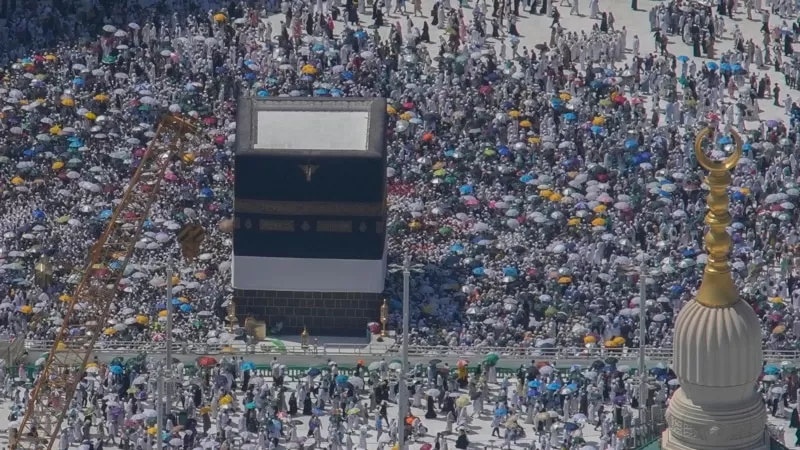
Mina, Saudi Arabia: The Hajj pilgrimage is well underway, with Muslim pilgrims braving the intense heat to participate in the sacred rituals. As they celebrate the Eid al-Adha holiday, over 1.8 million pilgrims have come together to fulfill their religious duty and follow in the footsteps of Prophet Ibrahim and his son Prophet Ismail.
The second day of the symbolic stoning of the devil took place in the early morning hours on Monday in Mina, a desert plain located just outside the holy city of Mecca. This important ritual, in which pilgrims throw pebbles at three pillars representing the devil, is a way to cast away evil and sin. A third stoning will take place on Tuesday, marking the end of this crucial aspect of the Hajj pilgrimage.
The Hajj is one of the Five Pillars of Islam, requiring all able-bodied and financially capable Muslims to undertake this journey at least once in their lifetime. The Hajj rites largely commemorate the Quran’s accounts of Prophet Ibrahim, his son Prophet Ismail, and Ismail’s mother Hajar. These stories are also found in the Bible, where they are known as Abraham, Ishmael, and Hagar.
Despite the soaring temperatures, with the mercury reaching 48 degrees Celsius (118 degrees Fahrenheit), more than 2,760 pilgrims suffered from sunstroke and heat stress on just the first day of stoning. Tragically, 14 Jordanian pilgrims have lost their lives due to heatstroke. However, despite this challenging environment, pilgrims from all over the world remain committed and determined to complete this sacred journey.
For Ahmed Al-Baradie, an Egyptian pilgrim, the harsh conditions have been challenging, but he understands the importance of perseverance. “Of course, it is something very hard and tiring. The temperature is abnormal compared to the past years and this affects us a lot,” he said after completing his second stoning. This sentiment is shared by many pilgrims, who display incredible resilience and faith in the face of such extreme weather.
The Saudi National Center for Metrology has reported that the temperatures in Mecca and the surrounding areas have reached record highs, making it difficult for the pilgrims to perform the rituals. The health authorities have taken extensive measures to ensure the safety and well-being of the pilgrims, with security forces, medics, and first responders deployed in and around Mina to assist and guide the pilgrims.
The stoning of the pillars represents the final days of the Hajj, coinciding with the celebration of the Eid al-Adha holiday. This important occasion commemorates Prophet Ibrahim’s submission to God’s command to sacrifice his son, which was then stayed by God. It is also a time for reflection, renewal, and seeking forgiveness from God.
The Hajj rituals officially began on Friday, when the pilgrims moved from Mecca’s Grand Mosque to Mina, then to Mount Arafat. They then return to Mina, where they will spend up to three days, each casting seven pebbles at three pillars in a symbolic act of purifying their souls.
While in Mina, the pilgrims also visit the sacred city of Mecca to perform a “tawaf,” or circumambulation, around the Kaaba, the cube-shaped building at the heart of the Grand Mosque. This is followed by the Farewell Tawaf, marking the end of the Hajj and the pilgrims’ preparedness to leave the holy city.
After completing the Hajj, the men will shave their heads, and the women will cut a lock of hair as a sign of renewal and rebirth. Many pilgrims will then travel to Medina, around 340 kilometers (210 miles) from Mecca, to pray in the Prophet Muhammad’s tomb in the Sacred Chamber.
This year’s Hajj has been a special one, with pilgrims coming from more than 22 different countries to take part in the journey. Despite the ongoing COVID-19 pandemic and the devastating Israel-Hamas conflict, this has not deterred the faithful from fulfilling their religious obligations.
The war has claimed the lives of over 37,000 Palestinians in Gaza, according to health officials, and hundreds more in the West Bank. Despite the difficulties, the pilgrims remain united in prayer and in their commitment to their faith. Sani Abdullah, a Nigerian pilgrim, expressed his admiration for the organization and preparation behind this