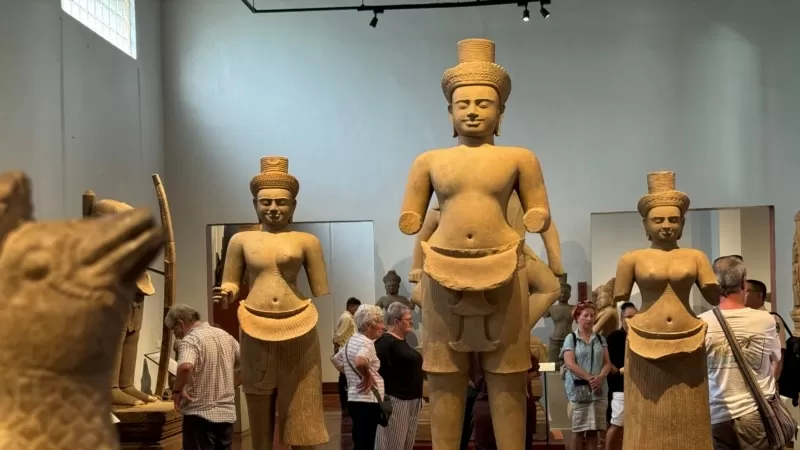
PHNOM PENH, CAMBODIA – Nhem Liza, a 15-year-old high school student from Phnom Penh, recently visited the National Museum of Cambodia for the first time. She was thrilled to learn about the return of dozens of looted Cambodian artifacts from the United States, including important Hindu and Buddhist masterpieces dating back to the ninth to 14th centuries.
“The artifacts are simply amazing,” Nhem exclaimed. The return of these statues, considered divine and containing the souls of ancestors, has given younger Cambodians like her a chance to reconnect with their cultural heritage and history.
“I am excited to see these artifacts that our government has been working hard to bring back,” she told VOA on September 16th after viewing some of the objects now on display at the museum.
For years, Cambodia has been tirelessly trying to identify and secure the return of culturally and historically significant relics from private collections and museums overseas. Many of these artifacts were lost due to war, theft, and the illegal trade of antiquities.
According to Cambodian officials, the country faced continuous civil unrest from the mid-1960s until the early 1990s, resulting in serious damage and widespread looting of archeological sites from the ancient Khmer Empire, such as Angkor Wat and Koh Ker.
In August, Cambodia celebrated the return of 70 items from museums and private collections overseas, including 14 from the Metropolitan Museum of Art in New York. These objects include priceless stone statues, such as one depicting a mythical warrior from the Hindu epic Mahabharata, as well as statues of Hindu deities Shiva and Parvati, and one of the Hindu god Ardhanarishvara from the ancient capital of Koh Ker, according to the Ministry of Culture and Fine Arts.
At the return ceremony, Prime Minister Hun Manet stated that these 70 returned objects symbolically reunite the Cambodian people with their “ancestral souls.” He also assured that the government will continue its efforts to bring back more artifacts to their rightful home.
Since 1996, a total of 1,098 artifacts have been returned to Cambodia, with 571 from private collections and 527 from foreign institutions and governments, according to Hun.
“The artifacts are the soul of our nation,” 18-year-old Doeun Sokun Aly told VOA at the museum. “The heroes of our country built these artifacts for the younger generation to learn about our history. I will visit museums more often to see more of these treasures.”
Chhay Visoth, the Director of the National Museum, expressed his hope that the display of these returned artifacts will spark a renewed interest among Cambodians, especially the younger generation.
“We have seen a surprising increase in Cambodian visitors to the museum, especially youth,” he said in a phone interview this week.
The authorities are now planning a “mobile exhibition” to showcase these artifacts at museums in provinces such as Siem Reap, Battambang, and Pursat in the northwestern part of the country.
Chhay also emphasized the importance of these artifacts to Cambodians and the need to protect them. He stated that the museum is already planning to expand its display area to accommodate more returned artifacts.
Over the years, Cambodia has received numerous statues from the families of wealthy collectors, such as George Lindemann, a U.S. businessman and philanthropist who passed away in 2018.
In 2021, after three years of negotiations, the family of the late British art collector Douglas Latchford agreed to return more than 100 Cambodian artifacts, according to the government. Latchford, who co-authored three books on Cambodian art and antiques, passed away in 2020 while facing accusations of illegally trafficking the artifacts to his homes in Bangkok and London.
In November 2019, federal prosecutors in New York charged Latchford with falsifying the provenance, invoices, and shipping documents to transport valuable Khmer-era relics to private collections, museums, and auction houses around the world.
Other cultural objects that have made their way back to Cambodia have gone through various processes, including voluntary returns, negotiations, seizures, and legal proceedings.
The United States has played a crucial role in securing the return of over 150 antiques to Cambodia so far, according to Wesley Holzer, a U.S. Embassy spokesperson in Phnom Penh. He stated that the United States is proud of