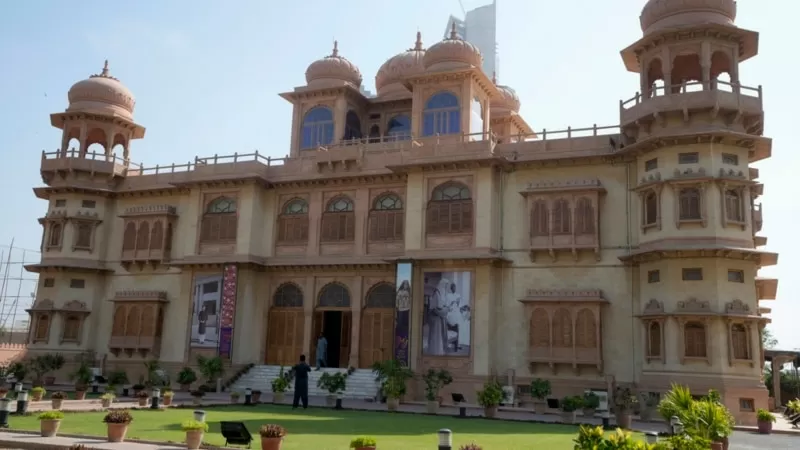
Karachi, the bustling megacity of Pakistan, is home to over 20 million people and is known for its vibrant culture, diverse communities, and rich history. Amidst the chaos and rapid development, lies a hidden gem that stands as a testament to the city’s past – the Mohatta Palace.
As visitors enter the grounds of the palace, they are greeted by the stunning stained glass windows, a sweeping staircase, and embellished interiors. The pink stone balustrades, domes, and parapets give the palace a distinct Rajasthani feel, a reminder of a time when Muslims and Hindus coexisted in the port city.
However, in a city where land is scarce and development is rampant, magnificence is no guarantee of survival. The Mohatta Palace, like many other historic sites in Karachi, is facing numerous challenges such as demolition, encroachment, neglect, and vandalism. These factors are slowly eroding the signs of Karachi’s past, and it is a race against time to preserve these precious remnants of history.
The trustees of the palace have been fighting to protect it from being turned into a dental college, but they are also facing a decades-long lawsuit from the heirs of a former owner who are trying to take control of the land. The palace sat empty for almost two decades before it was formally opened as a museum in 1999.
Located in the desirable neighborhood of Old Clifton, the Mohatta Palace sits on prime real estate among mansions, businesses, and upmarket restaurants. This makes it a coveted piece of land, and according to the palace’s lawyer Faisal Siddiqi, it is a sad reflection of how greed often takes precedence over heritage.
Karachi’s population is growing at a rate of 2% every year, and with dozens of communities and cultures competing for space, there is little effort to protect the city’s historic sites. For most Pakistanis, the Mohatta Palace is the closest they will get to experiencing the architectural splendor of India’s Rajasthan. The strict travel restrictions and hostile bureaucracies between the two countries make it challenging for people to cross the border for leisure, study, or work.
The multicultural past of Karachi also makes it harder to find champions for preservation compared to a city like Lahore, which has a strong connection to the Muslim-dominated Mughal Empire. According to Heba Hashmi, a heritage manager and maritime archaeologist, the scale of organic local community support needed to prioritize government investment in preservation efforts is nearly impossible to garner in a socially fragmented city like Karachi.
The Mohatta Palace is a symbol of Karachi’s diversity. It was built in the 1920s by Hindu entrepreneur Shivratan Mohatta, who wanted a coastal residence for his ailing wife to benefit from the Arabian Sea breeze. The construction of the palace was a massive undertaking, with hundreds of donkey carts carrying the distinctively colored pink stone from Jodhpur, now located across the border in India.
After partition in 1947, when India and Pakistan were carved out of the former British Empire as independent nations, Mohatta left the palace. It was then occupied by the Foreign Ministry before passing into the hands of Pakistani political royalty as the home of Fatima Jinnah, the younger sister of Pakistan’s first leader and a powerful politician in her own right.
After her death, the authorities gave the building to her sister Shirin, but a court battle erupted between people claiming to be her relatives. The court ordered the building to be sealed, and for a time, the palace was shrouded in mystery and rumors of spirits and supernatural happenings.
One person who heard these stories as a young girl was Nasreen Askari, now the museum’s director. She recalls being warned not to go near the “bhoot (ghost) bungalow” as a child. However, today, the palace draws visitors from all over the country who are eager to witness its architecture and history. Ahmed Tariq, a visitor from Bahawalpur, Punjab, was impressed by the palace’s well-maintained state and the effort put into its presentations.
Despite its popularity, the palace struggles to generate enough revenue to cover its maintenance costs. General admission is only 30 rupees (10 U.S. cents), and it is free for students, children, and seniors. On a sweltering afternoon, the palace only draws a trickle of visitors. Its opening hours from